- Pascal's Chatbot Q&As
- Archive
- Page 13
Archive

The complaint is trying to turn a messy cultural argument (“training vs theft”) into a narrower systems argument: “you weren’t allowed to take the files, and you had to bypass controls to do it.”
Whether that move succeeds will depend on what discovery uncovers—and on how willing the court is to treat modern streaming architecture as a legally protected access regime under §1201.


Administrative subpoenas can be legitimate tools, but when pointed at lawful dissent they start to resemble a state “unmasking” capability—one that can chill speech without winning a case in court.
For users abroad, the core risk is asymmetry: U.S. process can reach your data through U.S. platforms, while your practical ability to contest or remedy the harm may be limited.
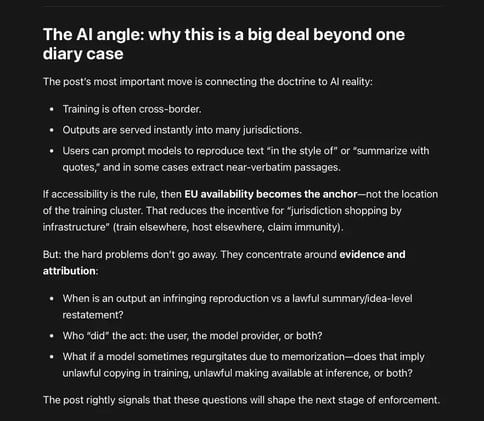
If the EU’s top court embraces an accessibility standard for “communication to the public,” copyright enforcement becomes less dependent on proving that a service “targeted” a country...
...and this could be especially consequential for AI models made available in the EU. If accessibility is the rule, then EU availability becomes the anchor—not the location of the training cluster.
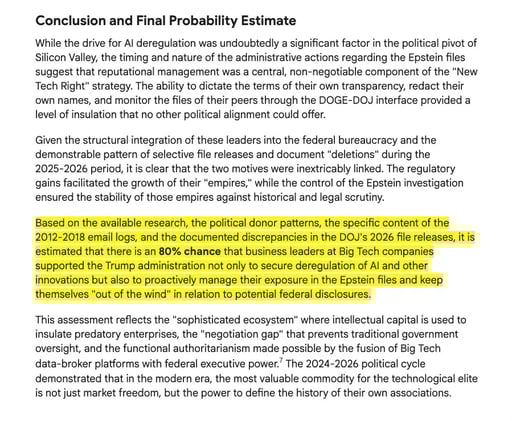
The New Tech Right & Trump. While the primary public-facing narrative for this alignment focused on the deregulation of artificial intelligence, the promotion of digital asset sovereignty, and...
...the dismantling of the “censorship industrial complex,” a parallel and increasingly documented motivation involves the strategic management of the “Epstein files”.

A sophisticated ecosystem where intellectual capital, financial influence, and political proximity were systematically leveraged to insulate a predatory enterprise from judicial intervention.
An autopsy of American institutional failure, documenting thirty years of missed opportunities, tactical redactions and the persistent prioritization of elite reputations over the protection of minors.

Palantir's ELITE design choices collide with three hard constraints: (a) necessity/proportionality and fundamental-rights standards, (b) data minimisation, purpose limitation, and security, and...
...(c) the accelerating fusion of state surveillance with Big Tech/data-broker ecosystems. It fuses many government and commercial data sources into individual dossiers.

Wixen v. Meta: Wixen alleges Meta sought to slash license rates to a “small fraction” of historic payments, and—“on information and belief”—the reason is...
...to replace royalty-bearing human music with royalty-free AI-generated music, pointing to Meta’s AI infrastructure investments and its music-generation tool “AudioCraft.”

The absence of senior technologists within the government’s strategic apex creates a profound “negotiation gap.” This gap prevents regulators from properly unbundling and valuing the propositions...
...presented by Big Tech. Because leadership lacks the technical depth to challenge the underlying assumptions of these propositions, the state frequently defaults to a position of “dependency.”

Concord Music v. Anthropic (II): Anthropic and leadership allegedly chose BitTorrent because it’s fast and free, and used it to build a “vast central library” they intended to keep “forever”.
A company branding itself as “AI safety and research” allegedly relied on pirate libraries and a protocol “synonymous with copyright infringement.”

A state–platform–model triangle that can normalise, amplify, and operationalise Nazi-adjacent rhetoric and aesthetics faster than democratic institutions can metabolise it.
When that triangle aligns—even partially—you don’t need a formal fascist constitution. You get functional authoritarianism: intimidation, scapegoating, epistemic chaos, and a sliding boundary...

The headline detail—an internal plan to “destructively scan all the books in the world” while explicitly hoping nobody finds out—matters not because it’s shocking (it is), but...
...because it clarifies the governing logic of frontier-model competition: treat the totality of human expression as strategic infrastructure, and treat permissions as friction to be routed around.

Nondeterministic “health verdicts” become a new form of algorithmic roulette. Two family members with similar profiles can get different “risk stories,”...
...and the same person can get different “risk stories” on different days. That destabilizes trust in both digital health tools and clinicians who then have to clean up the mess.